
EC Lecture 2 Genetic Algorithm
GA 简介
种群 Population
一群个体构成一个种群。
A number of individuals form a population.选择 Selection:适者生存 Survival of the fittest
个体越优秀,它被选作下一代父代的可能性就越大。
The better an individual is, the more likely it becomes a parent for the next generation.交叉 Crossover
子代的染色体 Chromosome由其父母的染色体组合而成。
The chromosome of a child is composed of chromosomes from its parents.变异 Mutation
在某些情况下,染色体的部分片段可以被随机改变。
In some occasions, some part of the chromosome can be randomly changed.
用“进化”求解优化问题 Use “evolution” to solve an optimization problem
- 在搜索空间 Search space中的一个解 Solution ↔ 自然进化中的一个个体 Individual。
- 我们可以称之为解、个体或点 Solution / Individual / Point。
- 进化 Evolution 的目的:不断“创造 Create”更好的解。
基本流程 Basic workflow
- 从一开始的解的种群 A population of solutions出发。
- 通过 选择 Selection 得到交配池 Mating pool(父代集合 Parent set)。
- 在交配池中应用 交叉 Crossover 与 变异 Mutation,生成新解 New solutions。
- 通过 替换 Replacement 操作,用新解更新种群,得到新的解的种群。
- 重复以上步骤,逐步进化出更优的解。
GA 表示,初始化,与选择 Representation, Initialization & Selection
GA 工作流
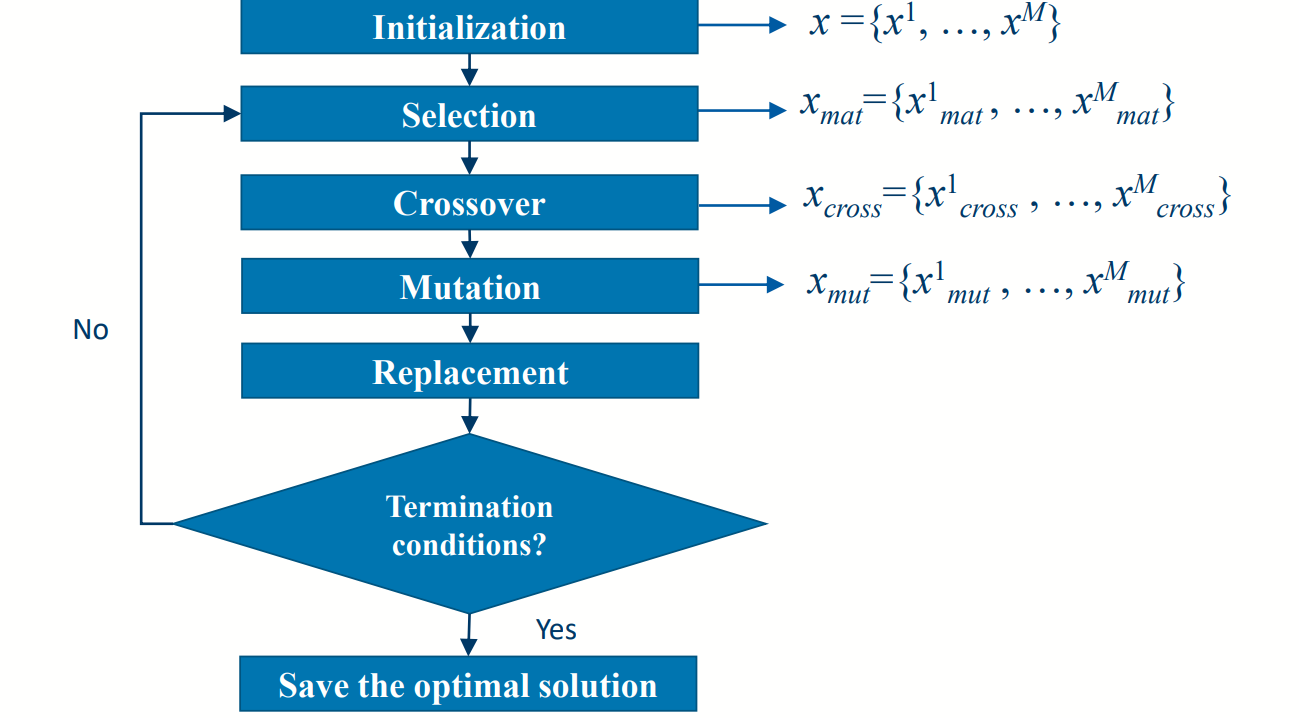
初始化 Initialization
生成初始种群 Population:其中
为种群规模。 选择 Selection
从当前种群中选出父代集合 Mating pool:交叉 Crossover
对父代进行交叉,产生新个体:变异 Mutation
对交叉后个体进行随机变异:替换 Replacement
用新个体替换部分或全部旧种群,形成下一代种群。终止条件 Termination conditions
若满足终止条件(例如达到最大代数、目标函数不再改善等),
则保存当前找到的最好解 Save the best solution found so far;
否则返回步骤 2 继续迭代。
表示 Representation
一个个体 Individual使用某种数据结构进行编码。
常见方式:二进制串 Binary string 编码,例如:
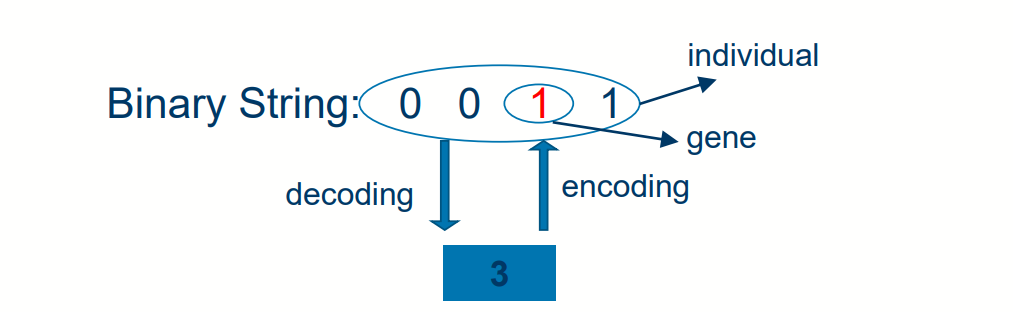
每一位是一个基因 Gene。
通过 解码 Decoding,二进制串可以映射为一个实际数值(例如);
通过 编码 Encoding,实际数值也可以转成二进制串。其他表示方式 Other representations:
- 排列 Permutation
- 实数 Real number
- 整数 Integer 等。
初始化 Initialization
GA 从一个初始种群 Initial population 开始:
- 种群 Population = 一组个体 Individuals。
需要考虑的两个关键问题:
- 种群规模 Population size:需要多少个体?
- 初始化方法 Initialization method:如何生成初始种群?
初始种群通常可通过随机采样 Random sampling获得。
选择 Selection
选择策略模拟自然界中的自然选择 Natural selection与适者生存 Survival of the fittest。
- 决定哪些个体进入交配池 Mating pool。
- 给“更好”的个体更多机会被选中 Give more chances to better individuals。
- 通过适应度函数 Fitness function区分“较好 better”与“较差 poorer”的解。
常见的选择策略 Popular selection schemes:
- 比例选择 Proportional selection
- 锦标赛选择 Tournament selection
- 截断选择 Truncation selection
比例选择 Proportional selection
考虑最大化如下函数的优化问题:
其中
在比例选择中:
个体被选为父代的概率 Probability与其适应度成正比:
适应度越高的个体,在交配池中出现的次数越多。
示例:初始种群(第
| 染色体 Chromosome | 说明 | |||
|---|---|---|---|---|
| 1 | 1011 | 56 | 0.55 | 最大概率 Maximum probability |
| 2 | 0010 | 29 | 0.28 | |
| 3 | 0001 | 16 | 0.16 | |
| 4 | 0000 | 1 | 0.01 | 最小概率 Minimum probability |
轮盘赌选择 Roulette Wheel selection
轮盘赌 Roulette wheel 常用于实现比例选择:
- 每个个体在“轮盘”上占据的区间与其适应度成正比。
- 转动轮盘,相当于按概率随机选择个体。
具体步骤:
计算种群中所有个体适应度之和:
计算累积适应度:
示例:
在
上产生一个随机数 。
根据所在区间选择个体: - 若
- 若
- 若
- 若
- 若
多次重复上述过程,就能根据各自概率构造出交配池 Mating pool。
从种群到交配池 From population to mating pool
在比例选择下,从种群到交配池的一个示例:
| Mating pool | |||||
|---|---|---|---|---|---|
| 1 | 1011 | 56 | 0.55 | 1011 | 56 |
| 2 | 0010 | 29 | 0.28 | 0010 | 29 |
| 3 | 0001 | 16 | 0.16 | 1011 | 56 |
| 4 | 0000 | 1 | 0.01 | 0001 | 16 |
可以看到适应度更高的染色体 1011 在交配池中出现两次。
选择的作用 The effect of selection
- 总体趋势:更好的个体 Better individuals在交配池中出现的拷贝数更多。
从两个角度看作用:
最优性 Optimality
- 若交配池中的“平均质量”高于原始种群:
Mating pool > Previous population - 选择将搜索引导到搜索空间中更有希望的区域:
Selection guides the search into a promising area in the search space。
- 若交配池中的“平均质量”高于原始种群:
多样性 Diversity
- 交配池中的候选解种类少于原始种群:
Mating pool < Previous population - 选择会减少候选解的多样性:
Selection decreases the number of different candidates。
- 交配池中的候选解种类少于原始种群:
仅有选择的局限性 Limitation of selection alone
若只有“选择”这个操作,在多代之后:
- 种群中的所有成员最终都会变成同一个个体——
初始种群中最好的那一个。
因此:
- 仅靠选择 Selection alone 不能解决优化问题 cannot solve the optimization problem。
- 还必须结合 交叉 Crossover 与 变异 Mutation 等算子,才能持续产生新解并跳出局部最优。
GA 交叉与变异 Crossover & Mutation
交叉 Crossover
新解 New solutions 通过 交叉 Crossover 和 变异 Mutation 操作产生。
这些算子具有以下特点:
- 直接作用在个体 Individuals上。
- 通常在选择 Selection 之后使用。
- 在大多数情况下,与适应度 Fitness没有直接关系(只依赖于编码本身)。
交叉操作的一般形式 General crossover operation
在交叉操作中,两个个体(父代)以某种方式互相交换染色体片段:
- 简单单点交叉 Simple (One-Point) Crossover
- 多点交叉 K-Point Crossover
示意(单点交叉前后):
- 交叉前 Before crossover
- Parent 1:
- Parent 2:
- Parent 1:
- 交叉后 After crossover
- Child 1:
- Child 2:
- Child 1:
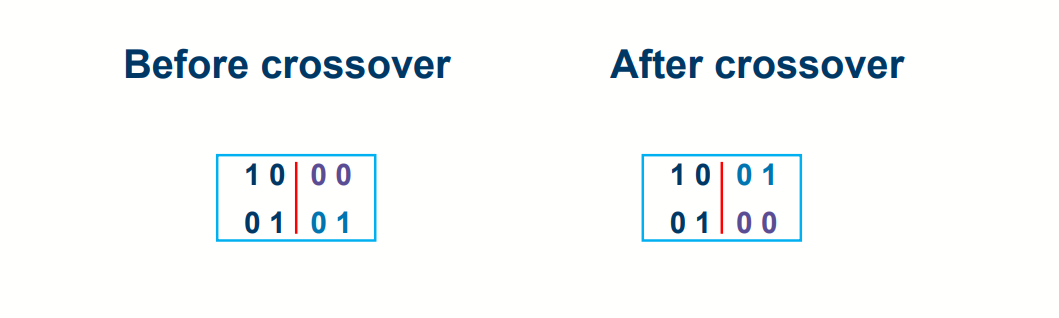
简单单点交叉 Simple (One-Point) Crossover
- 从交配池 Mating pool 中随机选择两个个体作为父代。
- 随机选择一个交叉位置 Crossover site。
- 在该位置之后的基因片段互换,产生两个子代。
示例(交叉位置为第
- Parent 1:
- Parent 2:
交叉后:
- Child 1:
- Child 2:
多点交叉 K-Point Crossover
K 点交叉 K-point crossover:选择
交叉点越多,重组方式越复杂。
示例(
与第 位): - Parent 1:
- Parent 2:
交换中间子串后:
- Child 1:
- Child 2:
- Parent 1:
交叉概率 Crossover rate
设交叉概率为
- 从交配池中成对选取父代。
- 生成一个
区间内的随机数 。 - 若
否则不执行交叉,父代直接作为后代。
典型取值:
- 当
可能变大也可能变小。 - 当
交叉的影响 Effects of crossover
- 在有限样本的情况下,交叉可能提高或降低平均适应度 Average fitness。
- 更重要的是:交叉显著增加种群的多样性 Diversity,通过重组基因探索新的搜索区域。
例子(部分数据):
| Mating Pool | 交叉后 | ||
|---|---|---|---|
| 1011 | 56 | 1010 | 61 |
| 0010 | 29 | 0011 | 40 |
| 1011 | 56 | 1011 | 56 |
| 0001 | 16 | 0001 | 16 |
可以看到部分个体适应度提高,部分保持不变。
交叉与早熟收敛 Crossover & Premature convergence
在某些情况下,如果种群已经高度相似,交叉只会在非常相近的染色体之间交换片段:
- 交叉前后产生的子代与父代几乎相同,无法产生真正新的个体。
- 此时,仅靠选择 Selection + 交叉 Crossover 仍然无法解决优化问题,会导致早熟收敛 Premature convergence。
因此,需要引入变异 Mutation算子。
变异 Mutation
在交叉之后,对个体中的基因施加随机扰动 Random perturbation:
在每个基因上,以一个较小的变异概率 Mutation probability
发生变异。 - 常见范围:
- 常见范围:
变异策略很多,这里以二进制串 Binary string为例:
- 对于每个位,按概率
将 变成 ,或将 变成 。
- 对于每个位,按概率
变异的作用:
- 以一定概率产生新个体 Generate new individuals。
- 帮助算法跳出局部最优,缓解早熟收敛问题。
- 与交叉一起,共同维持种群的多样性并探索搜索空间。
GA 停止准则与总结 Stopping Criterion & Summary
停止条件 Stopping condition
- 如果停止条件 Stopping condition没有满足,遗传算法 GA 会继续产生新的世代 New generations。
常见的停止条件 Some stopping conditions:
- 最大迭代代数 Maximum number of generations
- 得到满意的解 Satisfactory solution obtained
- 种群收敛 Population converges
进化机制 Evolution mechanism
交叉与变异 Crossover and mutation
- 提升种群多样性 Increase the population diversity
- 与适应度无直接关系 Has nothing to do with the fitness
- 侧重于产生新个体 Focus on generating new individuals
选择 Selection
- 降低种群多样性 Decrease the population diversity
- 在期望意义上提高种群平均适应度 Increase the expected average fitness
- 引导进入有前景的区域 Focus on entering promising areas
Advantages of GAs
- 是一种通用的优化方法 General optimization method,与具体问题领域 Problem domain无关。
- 使用种群 Population进行搜索,可以并行评估候选解 Candidate solutions。
- 具有产生多种最优/近似最优解的能力 Ability to generate various kinds of optimal solutions。
- 算法流程相对容易实现 The process is not difficult to implement。
Disadvantages of GAs
- 可能无法获得“非常高质量”的最优解 May not obtain a very high-quality optimal solution。
- 算法包含多个参数 Parameters,这些参数的选择会显著影响解的质量 Quality of the solution。
- 计算速度不快 It is not fast,在大规模问题上可能较耗时。