
Block 2 例题
- Lecture 5 Introduction to DFM & Design for Sustainability
- Lecture 6 Quality Control & Cost of Quality
- Lecture 7 Robust Manufacturing Design
- Lecture 8 Six-Sigma & Process Capability
Lecture 5 Introduction to DFM & Design for Sustainability
PROBLEM Q1
以下哪一项不是可持续设计原则?
Which item below is not an actionable sustainable design principle?
SOLUTION
答案 Answer: D
可持续设计强调延长产品寿命、减少资源消耗和降低环境负担,因此 "Design for a shorter period of usage" 与 DFS 的方向相反。
DFS aims for longer useful life, fewer resources, and lower environmental impact. Designing for shorter use is therefore not a DFS principle.
PROBLEM Q2
以下哪项最准确描述可持续性的三大支柱?
Which statement best describes the three pillars of sustainability?
SOLUTION
答案 Answer: B
可持续性要求同时平衡经济、环境和社会三大支柱,并且不损害后代满足自身需求的能力。
Sustainability balances the economic, environmental, and social pillars while protecting the ability of future generations to meet their own needs.
PROBLEM Q3
关于 DFM,以下哪项说法不正确?
Which statement about DFM is not correct?
SOLUTION
答案 Answer: D
DFM 的核心目标之一就是降低制造成本,同时提升质量、效率和客户满意度。因此 "higher manufacturing costs" 与 DFM 目标相反。
One core purpose of DFM is to reduce manufacturing cost while improving quality, efficiency, and customer satisfaction.
PROBLEM Q4
以下哪一项不是 DFM 原则?
Which item is not a principle of DFM?
SOLUTION
答案 Answer: D
广告策略属于市场推广,不属于 DFM 的制造设计原则。
Advertising strategy belongs to marketing, not design for manufacturing.
PROBLEM Q5
以下哪项不是循环经济 4Rs 原则?
Which item is not one of the 4Rs for circular economy?
SOLUTION
答案 Answer: E
Block 2 中的 4Rs 为 Reduce, Reuse, Repair, Recycle。
The 4Rs in this lecture are Reduce, Reuse, Repair, and Recycle.
PROBLEM Q6
DFM 在产品开发周期的哪个阶段最有效?
At which product development stage is DFM most effective in terms of highest impact and lowest cost of changes?
SOLUTION
答案 Answer: A
初始设计阶段变更成本最低、影响最大。越靠近生产和上市,设计改动越昂贵。
The initial design stage has the lowest change cost and the highest leverage. Changes become more expensive near production and launch.
PROBLEM Q7
以下哪项不是可持续性的三大支柱之一?
Which item is not one of the three pillars of sustainability?
SOLUTION
答案 Answer: D
三大支柱是 Economic, Environmental, Social。技术可以帮助实现可持续性,但不是该定义中的三大支柱之一。
The three pillars are economic, environmental, and social. Technology may support sustainability, but it is not one of the three pillars in this definition.
Lecture 6 Quality Control & Cost of Quality
PROBLEM Q1
关于 Pareto chart,哪项说法正确?
Which statement about a Pareto chart is true?
SOLUTION
答案 Answer: A
Pareto chart 用降序条形图突出 "vital few",帮助优先处理影响最大的原因。
A Pareto chart orders categories from largest to smallest so the vital few causes can be prioritized.
PROBLEM Q2
哪项最符合 control chart 的定义?
Which statement best fits the definition of control charts?
SOLUTION
答案 Answer: A
Control chart 通过中心线、UCL 和 LCL 监控制程随时间的稳定性。
Control charts use a center line, UCL, and LCL to monitor whether process variation remains stable over time.
PROBLEM Q3
以下哪项不属于 appraisal cost?
Which item is not classified as an appraisal cost?
SOLUTION
答案 Answer: D
Equipment upgrades 更接近预防成本,因为它是在缺陷发生前改善能力;appraisal cost 主要是检验、测试、审核和校准。
Equipment upgrades are closer to prevention cost. Appraisal costs are mainly inspection, testing, audits, and calibration.
PROBLEM Q4
以下哪项不是七大质量工具?
Which item is not one of the seven basic QC tools?
SOLUTION
答案 Answer: C
7-QC tools 为 Flowchart, Check Sheet, Cause-Effect Diagram, Pareto Chart, Control Chart, Histogram, Scatter Diagram。
Linear programming is an optimization method, not one of the seven basic QC tools.
PROBLEM Q5
Cause-and-effect diagram 主要用于什么?
In quality control, a cause-and-effect diagram is mainly used to:
SOLUTION
答案 Answer: B
鱼骨图用于把潜在根因按类别组织起来,例如 Man, Machine, Material, Method, Measurement, Environment。
A fishbone diagram organizes possible root causes, often through 6M categories.
PROBLEM Q6
质量培训费用和客户收到产品后的召回/保修维修费用应如何分类?
How should quality-related training and product recall/warranty repairs after customer delivery be classified?
SOLUTION
答案 Answer: A
培训用于预防缺陷,是 Prevention Cost;产品到客户后才发现问题,属于 External Failure Cost。
Training prevents defects, so it is a prevention cost. Recall and warranty after delivery are external failure costs.
PROBLEM Q7
PCB 制造商想随时间监控缺陷率,判断过程是否受控。最合适的 QC 工具是什么?
A PCB manufacturer wants to monitor defect rate over time and determine whether the process is under control. Which QC tool is most appropriate?
SOLUTION
答案 Answer: B
关键词是 "over time" 和 "under control",对应 control chart。
The key clues are "over time" and "under control", which point to a control chart.
Lecture 7 Robust Manufacturing Design
PROBLEM L7-E1
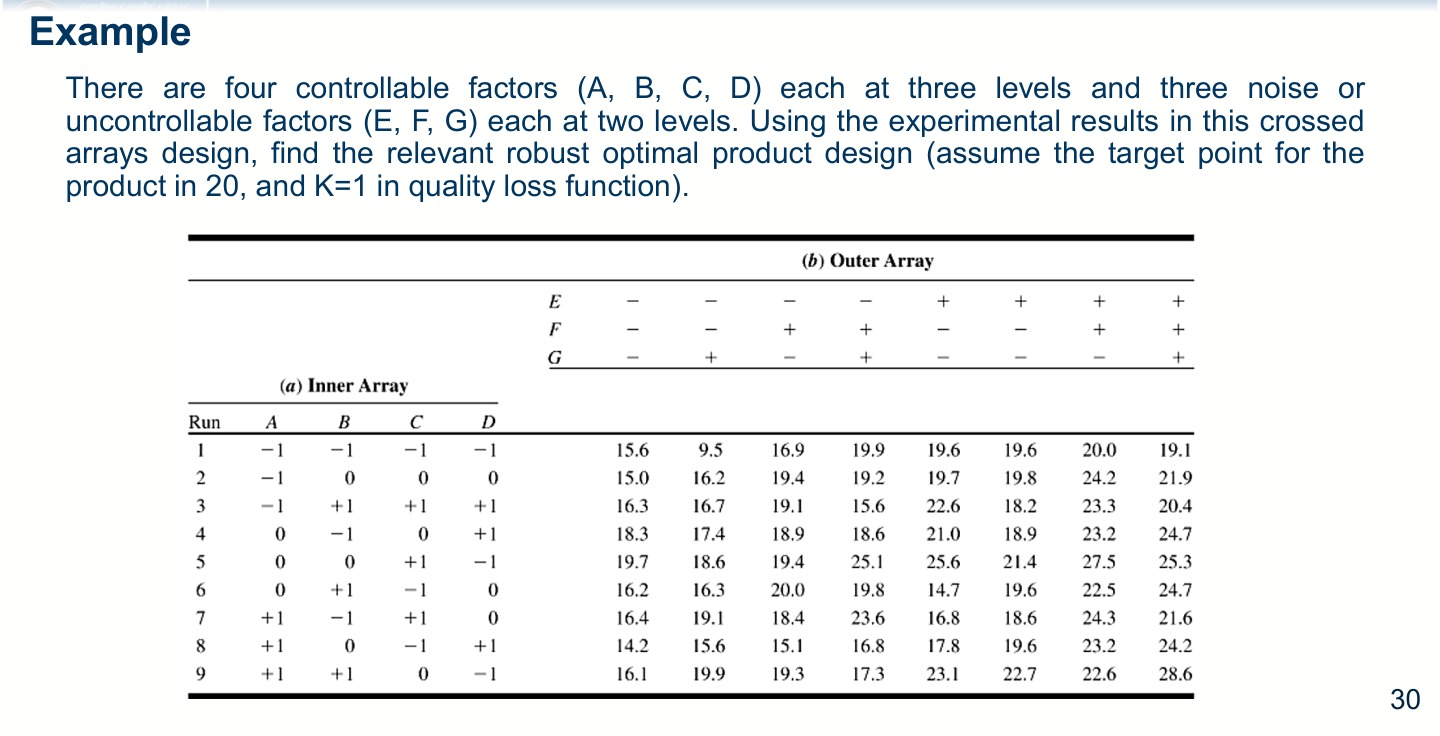
有四个可控因子 A, B, C, D,每个因子有三个水准;另有三个噪音因子 E, F, G,每个因子有两个水准。已知目标值
There are four controllable factors A, B, C, D at three levels each, and three noise factors E, F, G at two levels each. The target is
SOLUTION
本题外侧阵列包含 3 个二水平噪音因子,因此每个内侧 run 有
Because there are three two-level noise factors, each inner-array run has
对每一行直接计算平均损失:
For each row, compute average loss directly:
| Run | A | B | C | D | ||
|---|---|---|---|---|---|---|
| 1 | -1 | -1 | -1 | -1 | 17.525 | 17.545 |
| 2 | -1 | 0 | 0 | 0 | 19.425 | 7.727 |
| 3 | -1 | +1 | +1 | +1 | 19.025 | 8.225 |
| 4 | 0 | -1 | 0 | +1 | 20.125 | 5.920 |
| 5 | 0 | 0 | +1 | -1 | 22.825 | 18.260 |
| 6 | 0 | +1 | -1 | 0 | 19.225 | 10.595 |
| 7 | +1 | -1 | +1 | 0 | 19.850 | 7.818 |
| 8 | +1 | 0 | -1 | +1 | 18.313 | 15.016 |
| 9 | +1 | +1 | 0 | -1 | 21.200 | 15.078 |
最小平均损失出现在 Run 4:
The minimum average loss occurs at Run 4:
这组参数的均值最接近目标值,同时在噪音条件下的平均损失最低。
This factor combination is closest to the target while producing the lowest average loss under noise conditions.
PROBLEM Q1
以下哪项不是常见的田口损失函数类型?
Which item is not one of the common Taguchi loss function types?
SOLUTION
答案 Answer: D
常见类型是 Nominal-the-best, Smaller-the-better, Larger-the-better。
The common Taguchi loss-function types are nominal-the-best, smaller-the-better, and larger-the-better.
PROBLEM Q2
在 robust design 中,响应
In robust design, response
SOLUTION
答案 Answer: A
P Diagram 的核心分类包括 signal factors, control factors, noise factors。
The P Diagram classifies inputs into signal factors, control factors, and noise factors.
PROBLEM Q3
某 nominal-the-best 品质特性的目标值为 8.5,损失系数
For a nominal-the-best quality characteristic, target
平均田口损失是多少?
What is the average Taguchi loss?
SOLUTION
按平均损失定义:
Using the average-loss definition:
代入数据:
Substituting the data:
也可先算
Equivalently, with
NOTE
PDF 的选项中没有与题面数据完全一致的数值;若课堂给出了指定选项,应以教师标注为准。按题面数据和公式计算,结果为 0.1595。
Lecture 8 Six-Sigma & Process Capability
PROBLEM L8-E1
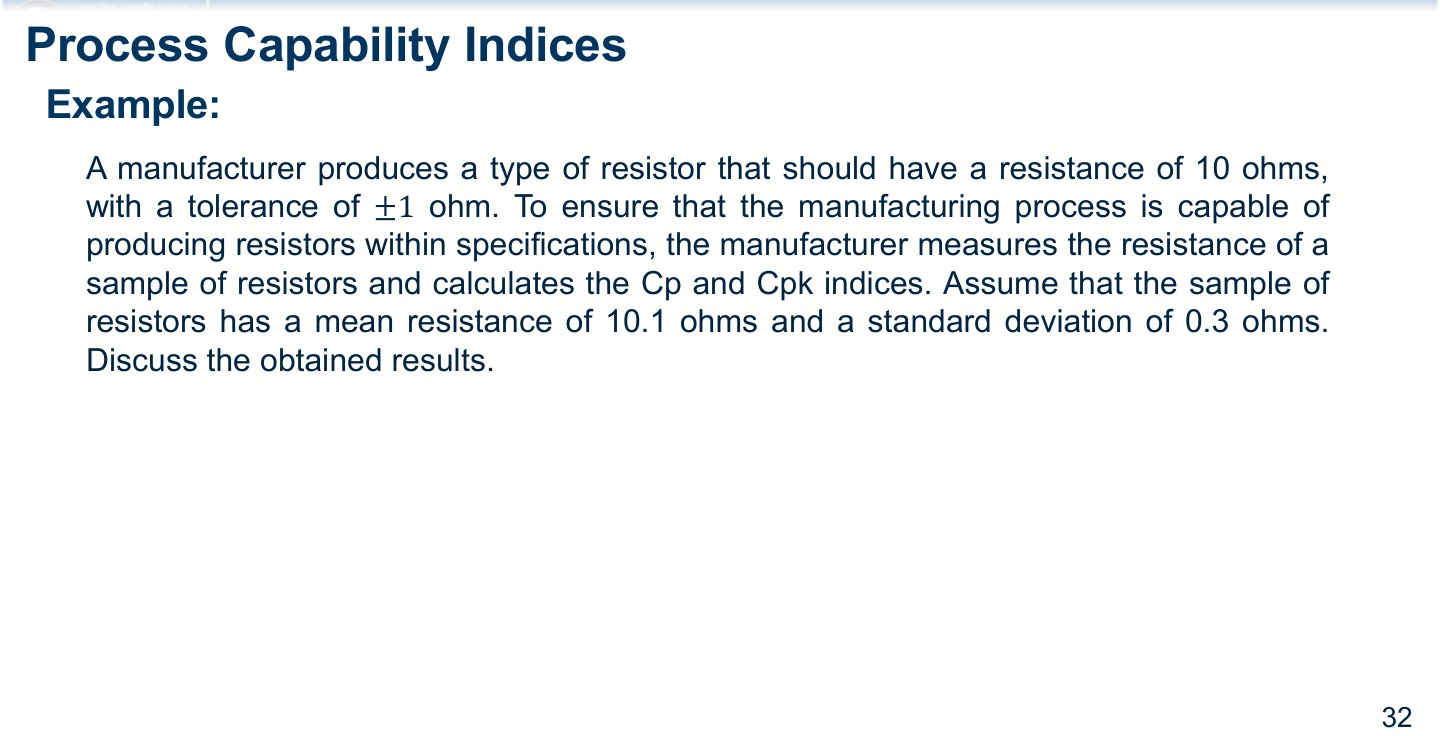
某制造商生产目标电阻为 10 ohm 的电阻器,公差为
A manufacturer produces resistors with target resistance 10 ohm and tolerance
SOLUTION
规格限为:
Specification limits:
潜在制程能力:
Potential process capability:
实际制程能力:
Actual process capability:
Since
PROBLEM Q1
关于 process capability,哪项说法正确?
Which statement about process capability is true?
SOLUTION
答案 Answer: B
Process capability 关注制程输出是否能稳定满足规格要求。
Process capability asks whether the process can consistently produce outputs within specification limits.
PROBLEM Q2
Six Sigma 中 CTQ 指什么?
In Six Sigma, what does Critical-to-Quality (CTQ) refer to?
SOLUTION
答案 Answer: A
CTQ 是对输出质量有显著影响的关键要素,是把客户要求转化为可测量指标的入口。
CTQs are key elements that significantly affect output quality and translate customer requirements into measurable characteristics.
PROBLEM Q3
某产品规格为
A process has specification limits
SOLUTION
答案 Answer: C
PROBLEM Q4
Which statement correctly describes a process with
SOLUTION
答案 Answer: B
在本讲义的风险表中,
In the lecture risk table,
PROBLEM Q5
以下哪个
Which
SOLUTION
答案 Answer: D
本讲义中
The lecture classifies
PROBLEM Q6
DMAIC 中哪项不是五个阶段之一?
Which item is not one of the DMAIC phases?
SOLUTION
答案 Answer: D
DMAIC 为 Define, Measure, Analyze, Improve, Control。
DMAIC stands for Define, Measure, Analyze, Improve, and Control.